Every time a garment enters a washing machine, a complex chemical reaction takes place. The fabric isn't just a piece of cloth; it is a matrix of fibers some natural, some synthetic each with its own "breaking point" regarding heat, moisture, and alkalinity. In the Nigerian professional landscape of 2026, where luxury fashion and high-quality traditional attire are major investments, "standard" washing is no longer enough.
Understanding fabric types and how to wash them is the core competency of a successful laundry business. Treating a N150,000 silk Kaftan the same way you treat a pair of denim jeans is a recipe for business failure and costly damage claims. By utilizing the best tool to manage your laundry business, CloudLaundry, you can standardize your fabric identification process. Our platform allows you to tag items by material type during intake, automatically triggering specific washing protocols for your staff, ensuring that the "science of the wash" is applied perfectly every time.
Cellulose Fibers (Cotton and Linen)
Cotton and linen are the workhorses of the textile world. Derived from plants, these fibers are incredibly strong, especially when wet, but they are prone to shrinking and wrinkling.
- The Wash Protocol: Cotton can handle high temperatures (up to 60°C for whites) and high mechanical agitation. However, for colored cottons, 30°C to 40°C is preferred to prevent fading.
- The Detergent: These fibers thrive with standard alkaline detergents that lift organic oils and sweat.
- The Professional Tip: Linen should never be "bone-dried" in a machine. It becomes brittle. Professional laundries pull linen out while slightly damp to finish with a high-pressure steam iron.
Protein Fibers (Silk and Wool)
Silk and wool are essentially "animal hair." They are made of proteins, making them highly sensitive to the environment.
- The Danger Zone: High heat causes wool to "felt" (the fibers lock together, causing permanent shrinkage). High pH (alkalinity) dissolves the natural luster of silk, making it feel "crunchy."
- The Wash Protocol: These should be washed in cool water (under 30°C) with minimal agitation. In many cases, professional "Wet Cleaning" or Dry Cleaning is the only safe option.
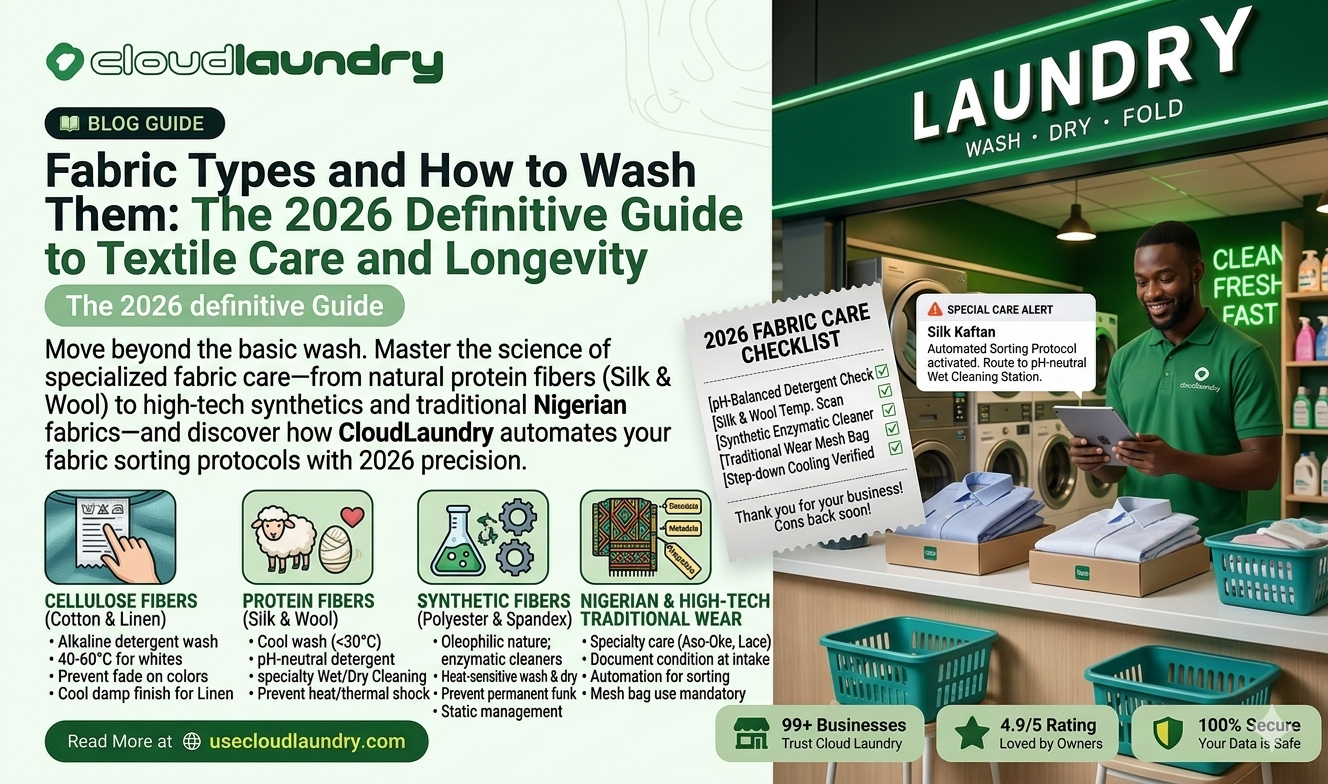
- CloudLaundry Integration: Use [CloudLaundry] to flag these items as "Specialty Care" automatically. When a silk item is scanned, the app should prevent the user from moving it to the "Standard Wash" queue.
Synthetic Fibers (Polyester, Nylon, and Spandex)
Synthetics are born in a laboratory. While durable, they have a unique problem: they are "oleophilic," meaning they love oil.
- The Wash Protocol: Synthetics are heat-sensitive. High dryer temperatures can "melt" the fibers, leading to a permanent glaze or loss of elasticity (especially in gym wear).
- The Odor Problem: Because they trap oils, synthetics can develop a "permanent" funk. In 2026, professionals use specialized enzymatic cleaners to break down these trapped body oils.
- Static Management: Synthetics are prone to static cling. Using a professional-grade fabric softener or anti-static dryer sheet is essential for a retail-ready finish.
The Rise of "High-Tech" Performance Fabrics
In 2026, "Dri-Fit" and moisture-wicking materials are common.
- The Wicking Science: These fabrics have microscopic channels that pull sweat away from the skin.
- The Mistake: Using standard fabric softeners on performance wear coats these channels in "wax," destroying the fabric's ability to breathe.
- The Rule: Always wash performance wear inside out, in cool water, and never use softener.
Traditional Nigerian Fabrics (Aso-Oke and Lace)
Nigeria has a rich heritage of complex textiles that require localized expertise.
- Aso-Oke: Often hand-woven with metallic threads. Mechanical washing can snap these threads. Hand-washing or very low-agitation wet cleaning is mandatory.
- Heavy Lace: The danger here is "snagging." A single loose thread on a lace gown can unravel an entire panel. Always use mesh laundry bags.
- Documentation: Use the CloudLaundry camera feature to document the condition of embroidery and beadwork at intake to protect your business from pre-existing damage claims.
Understanding Water Temperature and "Thermal Shock"
Temperature is a tool, but it can also be a weapon.
- Hot (60°C+): Only for heavily soiled white cottons, towels, and bedsheets. It kills bacteria and dust mites.
- Warm (40°C): The standard for most everyday wear. It balances cleaning power with color protection.
- Cold (30°C and below): Mandatory for delicates, bright colors that bleed, and wools.
- Thermal Shock: Moving a garment from a hot wash directly into a cold rinse can cause some fibers to contract so violently they lose their shape. Professional machines in 2026 use a "step-down" cooling process.
The Role of pH in Fabric Conservation
Professional laundry chemistry is all about the pH scale.
- Alkaline (High pH): Great for removing heavy grease but hard on natural fibers.
- Acidic (Low pH): Used in "souring" rinses to neutralize alkaline detergent and brighten colors.
- Neutral (pH 7): The safe zone for silk and wool.
- CloudLaundry Inventory: Track your chemical usage in [CloudLaundry]. Ensure your team is using "Wool & Silk" detergent for protein fibers and "Heavy Duty" only for industrial cottons.
Sorting: The First Line of Quality Control
Sorting is the most underrated part of the laundry process.
- Sort by Color: Whites, Lights, Darks, and "Bleeders" (Reds/Navys).
- Sort by Weight: Don't wash heavy denim with light t-shirts. The friction of the heavy denim will "pill" the lighter fabric.
- Sort by Soil Level: Greasy work clothes should never share a bath with delicate office shirts.
Case Study: The "Cashmere Crisis" Averted
A high-end laundry in Victoria Island received a batch of 10 cashmere sweaters from a VIP client. The junior staff member almost threw them into a standard 40°C cotton cycle. However, because the business uses CloudLaundry, the system flagged the order as "Premium Delicate" the moment the tags were scanned. The machine operator received an instant alert on their station tablet: "STOP: Cashmere detected. Route to Hand-Wash Station." The sweaters were safely cleaned using a pH-neutral soak and flat-dried. The client, impressed by the fluffiness and lack of shrinkage, signed a yearly retainer for his entire family's wardrobe.
How CloudLaundry Standardizes Fabric Care
CloudLaundry is the best tool to manage your laundry business because it removes the "human error" factor from fabric care:
- Digital Care Labels: Can't read the faded care label? [CloudLaundry]'s database can provide standard instructions based on the garment type and brand.
- Technician SOPs: Every fabric type in your system can be linked to a digital Standard Operating Procedure (SOP).
- Machine Integration: In some advanced setups, CloudLaundry can send the correct cycle settings directly to your smart commercial washers.
- Quality Audits: Use the app to perform random checks—ensure that "Wool" items are actually being dried flat as per the protocol.
Conclusion: Knowledge is the Ultimate Detergent
Mastering fabric types and how to wash them is a lifelong journey for a professional. As textile technology evolves, so must your techniques. In 2026, being a "good laundry" means being a "smart laundry."
By combining your technical expertise with the data-driven oversight of CloudLaundry, you protect your customers' most valuable assets and build a brand defined by excellence. You don't just wash clothes; you extend their life. Visit usecloudlaundry.com today to see how we can help you manage your fabric protocols with 2026 precision.