Opening a laundry business in Nigeria is a high-potential investment, but your success is directly tied to the tools you choose. Many entrepreneurs assume that "washing clothes is washing clothes," only to see their new domestic machines break down under the weight of commercial demand in Ikeja or Abuja.
In 2026, the competitive edge is reliability and turnaround time. If you can promise (and deliver) 24-hour service during the rainy season, you will dominate your local market. But you cannot do this with a basic home washer.
This article is your definitive technical blueprint. We will look at the exact equipment needed for a laundry business in Nigeria, breaking it down by category, necessity, and the critical adjustments you must make for the unique Nigerian operating environment.
The Primary "Wash and Dry" Infrastructure
This is the heart of your operation. Do not buy residential equipment; commercial units are built with stronger components (motors, suspension) that can withstand constant use.
1. Washing Machines
Need: To clean clothes efficiently. Commercial machines use less water and finish faster.
Nigerian Context: Look for "semi-industrial" or full "washer-extractors." Brands like LG Commercial, Hisense, and Danube are popular. Aim for a capacity of 10kg to 15kg for standard operations.
Pro Tip: If you can afford it, a small "front-load" industrial washer looks more professional and is easier on the clothes than the standard "top-load" design.
2. Tumble Dryers
Need: This is non-negotiable for a professional operation in 2026. Nigerian customers do not want their clothes hanging outside in the rain and dust. A dryer allows for a 24-hour turnaround regardless of the weather.
Gas vs. Electric: Given the cost of electricity and the scarcity of "light" in most commercial areas, Gas Dryers are the superior choice. The initial cost is higher, but the operating expense is vastly lower.
The "Pressing" Station (Where Margins are Made)
This is where domestic tools usually fail first. A ₦15,000 steam iron from a supermarket cannot produce the "agbada-perfect" crease that Nigerians demand.
1. Industrial Steam Irons & Boilers
Need: These irons have separate water boilers and produce a continuous, high-pressure flow of steam. This allows you to remove tough wrinkles in seconds rather than minutes.
Brands: Silter, Comel, or similar generic Turkish/Chinese boilers are industry standard.
2. Vacuum Ironing Tables
Need: A standard ironing board is not enough. A vacuum table uses a powerful motor to pull air through the garment, instantly drying the fabric as you iron. This locks the crease into place, prevents the "wet shirt" feel, and significantly speeds up production.
3. Stain Removal (Spotting) Station
Need: A specialized table and a "gun" that applies pressurized steam or air to target localized stains (oil, makeup, ink) before or after washing. This is often the difference between a satisfied customer and a compensation claim.
Critical Power and Water Adjustments for Nigeria
You can have the best machines in the world, but if they cannot turn on or don't have water, they are just expensive decoration.
1. The Generator (Your True Power Source)
Need: "NEPA" (or PHCN) is a variable. You must assume you will be on generator power for 60-80% of your operational hours.
Sizing: You must size your generator based on your total load.
If running only industrial irons and one washer, a 15KVA Soundproof Generator is the minimum safe size.
If running multiple large commercial dryers and washers, you may need a 30KVA to 60KVA unit.
Fuel Type: Diesel is more reliable and robust than gasoline for heavy motors, but the running cost is high. Solar hybrid setups are increasingly common in 2026 for lighting and POS management.
2. Water Storage and Treatment
Need: Most commercial shops do not have stable tap water.
Setup: You need a minimum of two 2,500-liter storage tanks (GP tanks). One is for raw water; the second should be for filtered or treated water. Laundry with heavy bore-hole water containing iron (the "brown" water that stains whites) is a quick way to lose clients. A simple sand-filtration system is essential in most parts of Port Harcourt and Lagos.
Operational Toolkit (The Small Things That Matter)
These small items prevent the chaos that destroys new businesses.
1. Garment Tagging System
Need: Every item that enters your shop must be tagged immediately with a unique ID. Never use permanent markers on clothes.
Toolkit: Tagging guns, colored rolls (for sorting), and clear barcodes.
2. Shelf Management
Need: You must have a physical rack with designated "Bins" or "Sections" to store clothes.
Pro Tip: Number your shelves! This links directly to your digital management system.
3. Packaging Materials
Need: Branded, clear nylon bags, premium hangers, and collar boards for shirts. This is what transforms a "washman's" work into a "dry-cleaner's" service.
The Digital Equipment (Management)
In 2026, a notebook is not an option; it's a financial death sentence. A professional setup includes:
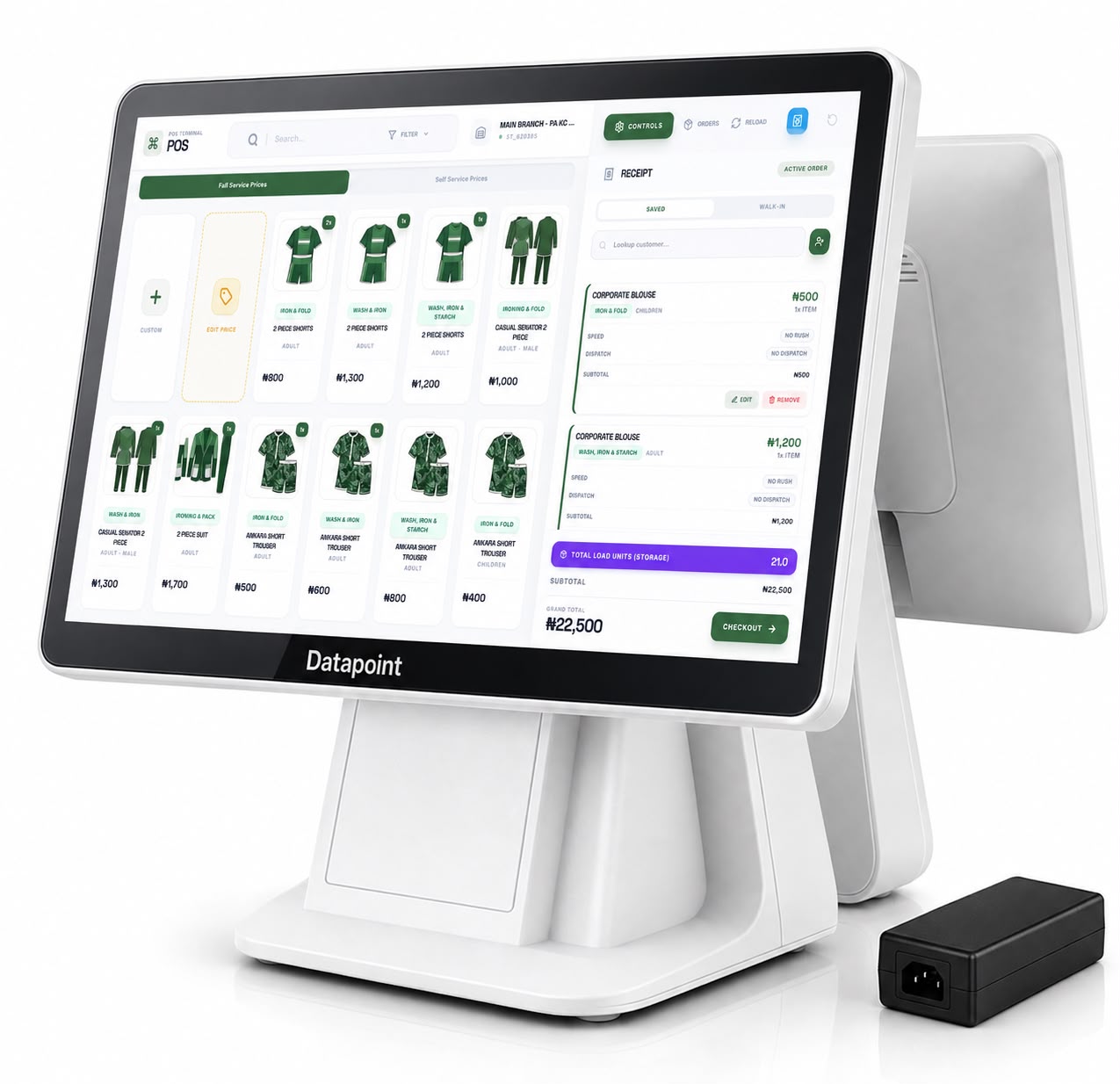
The POS Unit/Computer: A desktop, laptop, or professional all-in-one POS machine.
Thermal Receipt Printer: To give professional, readable receipts.
Software: A management system tailored for Nigerian conditions. This is where CloudLaundry comes into play.
Practical Example (The "Manual Nightmare" vs. "Digital Efficiency")
Consider a small laundry in Owerri, Imo State. The owner invested ₦1.5 Million in used semi-industrial equipment but decided to "save money" by not buying software, using paper receipts and tags instead.
During a busy Christmas period, a mix-up occurred. Three custom-made traditional wear garments for a wedding were handed to the wrong customer. They couldn't track where they went, and the paper receipt was useless. They spent ₦250,000 on compensation and lost the client, wiping out their entire profit for the season.
The next month, they purchased CloudLaundry and a thermal printer. Now, every item gets a digital receipt with a unique ID. Staff can't log an order without assigning it to a numbered shelf (B-4, C-1, etc.). When a customer arrives, they just check the app and retrieve the item in seconds. They haven't lost a garment in 18 months. Their secret wasn't a bigger washer; it was digital organization.
How CloudLaundry Optimizes Your Equipment Investment
Your physical machines are massive investments. CloudLaundry is the brain that makes those machines profitable.
- Prevent "Free Washes": If staff use your machines for their personal hustle without logging it, you lose money. Our system matches daily sales with logged orders.
- Prevent "Side Deals": Staff cannot generate a receipt without logging it into the system, making it impossible for them to take cash and not record the sale.
- Equipment Monitoring: We are launching features to help you track maintenance schedules for your generators and washers, preventing costly breakdowns.
CloudLaundry is the essential digital equipment you need to protect your investment in physical equipment.
Conclusion
Buying the equipment needed for a laundry business in Nigeria is the first technical decision you will make, and it dictates your profitability for years to come. Do your research, size your power appropriately, and never skimp on the organizational tools, whether physical tags or digital systems like CloudLaundry. Your equipment washes the clothes, but your system keeps the profit.
Ready to launch your laundry with the ultimate checklist? Visit usecloudlaundry.com and start organizing your empire today!