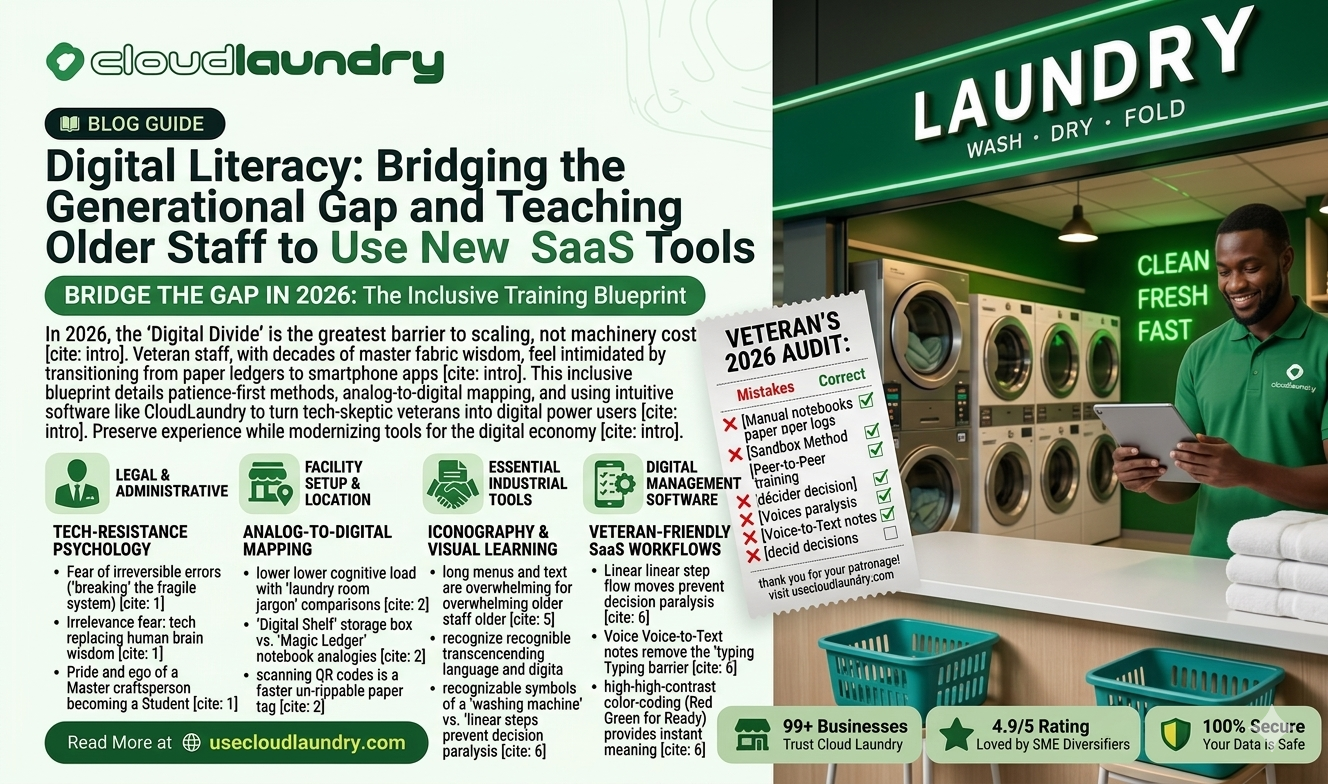
By 2026, the laundry industry in Nigeria has officially entered its "Silicon Age." Every aspect of the business, from chemical dosing to delivery logistics, is now mediated by software. However, this progress creates a unique management crisis: the "Digital Literacy Gap." On one side, you have younger "Digital Natives" who can navigate a new app in minutes but lack the fundamental knowledge of how to handle delicate lace or identify a protein-based stain. On the other side, you have your “Veteran Staff” the backbone of your quality control who can tell a fabric's blend just by touching it, but who break into a sweat at the sight of a "Cloud-Based Dashboard."
Teaching older laundry staff digital literacy 2026 is about more than just showing someone where to click. it is an exercise in "Change Management" and "Psychological Safety." For a veteran who has spent 20 years using a physical notebook to track orders, a tablet feels like a threat to their competence. They fear that a "wrong click" will delete the business or that the technology is a precursor to their replacement. To scale your business, you need their wisdom and the software’s efficiency. The best tool to manage your laundry business, CloudLaundry, is designed with this specific challenge in mind, offering a "Simplified Mode" and an icon-heavy interface that mimics physical workflows, making the transition from paper to screen feel like a natural evolution rather than a digital revolution.
The Psychology of Tech-Resistance in Veterans
To teach effectively, you must first understand the root of the resistance. It is rarely about "laziness" and almost always about "Anxiety."
Common Barriers for Older Staff:
Fear of "Breaking" the System: Younger people treat software as something to explore; older staff often treat it as something fragile. They worry that an error is irreversible.
The "Irrelevance" Fear: They worry that if the software can "count the clothes," the business won't need their brain anymore.
Physical Limitations: Small fonts, high-glare screens, and "touch-sensitivity" can be physically frustrating for aging eyes or hands calloused by years of heat and steam.
Pride and Ego: It is difficult for a "Master" of their craft to suddenly become a "Student" of a 22-year-old manager on how to use a phone.
The "Analog-to-Digital" Mapping Strategy
The most successful way to teach a new SaaS tool like CloudLaundry is to use "Analogies." Don't use tech jargon; use the language of the laundry room.
The Comparison Framework:
The "Digital Shelf": Instead of explaining "Database Storage," explain that CloudLaundry is like a giant, invisible shelf where every customer's bag is kept in its own neat box.
The "Digital Tag": Explain that scanning a QR code is just a faster, "un-rippable" version of the old paper tags they used to staple to the hangers.
The "Magic Ledger": Describe the dashboard as a notebook that "writes itself" every time they finish a task. By anchoring the technology in their existing world, you lower the "Cognitive Load" required to learn.
Creating a "Failure-Safe" Training Environment
If the first time an older staff member uses the app is with a real customer’s ₦200,000 Agbada on the line, they will fail due to pressure.
The "Sandbox" Method: Set up a "Training Account" in usecloudlaundry.com that isn't connected to live orders.
The "Play" Phase: Give them the tablet and tell them: "Try to break this. Delete things, click everything, make mistakes." When they see that the world doesn't end and that "Undo" exists, their anxiety drops.
The "Dummy Order" Run: Have them process 10 "Fake Orders" of shop rags or towels. This builds "Muscle Memory" without the high stakes of a paying customer.
The "Buddy System": Pair a "Tech-Native" junior with a "Fabric-Native" veteran. The junior helps the veteran with the app, and the veteran teaches the junior how to properly press a pleat. This creates mutual respect and stops the "Generational Cold War."
Physical Accommodations for Digital Tools
Sometimes the barrier to digital literacy isn't mental; it's biological. In 2026, inclusive design is a business requirement.
Hardware Hacks for Older Staff:
Large-Format Tablets: Avoid using small smartphones for backroom staff. A 10-inch tablet provides larger buttons and clearer text.
Adjustable Font Sizes: Use the settings in CloudLaundry to maximize text size.
Stylus Use: For staff whose fingers are less nimble due to years of manual labor, a stylus pen can make "tapping" and "signing" much easier than using a finger.
Anti-Glare Screens: Since laundry facilities are often brightly lit or have natural sunlight, anti-glare protectors make the screen much easier for aging eyes to read.
The "Iconography" Advantage: Visual Over Verbal
Older staff often find long menus and text-heavy screens overwhelming. They react better to "Symbols."
Visual Learning in 2026: In CloudLaundry, the workflow is built around recognizable icons: a "Washing Machine" icon for washing, a "Hanger" icon for ready orders, and a "Truck" for delivery. Teaching a staff member to "Click the Blue Truck" is significantly more effective than saying "Navigate to the Logistics Sub-Menu and initiate the dispatch protocol." Visual cues transcend both the digital gap and potential language barriers.
How CloudLaundry Simplifies the Veteran Journey
A complex, cluttered software will always fail with older staff. In 2026, the mantra is "Powerful Back-End, Simple Front-End."
As the best tool to manage your laundry business, usecloudlaundry.com is engineered to be "Veteran-Friendly":
- Linear Workflows: CloudLaundry doesn't present 50 options at once. It uses a "Step-by-Step" flow. The staff member sees one task: "Scan the Bag." Once that’s done, the next task appears: "Count the Items." This prevents the "Decision Paralysis" that often halts tech adoption.
- Voice-to-Text Notes: Many older staff are excellent at speaking but slower at typing on a screen. CloudLaundry allows them to tap a microphone and say: "Customer wants no starch on the collar," and the system transcribes it perfectly. This removes the "Typing Barrier."
- High-Contrast Design: CloudLaundry uses a color-coded status system (Red for Late, Green for Ready) that provides "Instant Meaning" without needing to read the details.
- Error-Correction Prompts: If a staff member tries to mark an order as "Ready" without completing the "Inspection" step, CloudLaundry provides a polite, clear pop-up: "Wait! Don't forget to take the photo." This acts as a "Digital Assistant" that guides them through the process. By using CloudLaundry, you aren't forcing your veterans to become computer scientists; you are giving them a digital tool that speaks their language. CloudLaundry makes technology feel like a "Support" rather than a "Surveillance" tool.
Incentivizing the "Digital Leap"
Change is hard. You must answer the question: "What's in it for me?"
The "Digital Bonus" Structure: Tie their transition to the app to their personal benefits:
The "Error-Free" Bonus: Show them that because CloudLaundry prevents them from losing items or missing instructions, they are more likely to hit their "Quality-Locked Bonus" (as discussed in previous guides).
Workload Transparency: Show them that the app proves how much work they are doing, ensuring the boss knows they are the hardest worker in the room.
Early Adoption Rewards: Offer a small "Tech-Master" certificate or a small cash bonus for everyone who completes their digital training modules.
The "Patience-First" Management Culture
If the manager gets frustrated, the staff member will shut down. You cannot "bully" someone into digital literacy.
The Training Temperament:
Short Bursts: Never do a 4-hour training session. Do 15 minutes a day, every morning.
Repeat, Repeat, Repeat: Older learners often need to see a process three or four times before the "Logic" clicks.
No "Stupid Questions": Create an environment where asking "How do I turn this on?" for the fifth time is met with a smile and a demonstration. Once they feel safe to ask, they will feel safe to learn.
Leveraging "Digital Mentorship"
Sometimes the best teacher isn't the owner; it's the person standing next to them at the ironing board.
The "Peer-to-Peer" Model: Identify a "Champion"—an older staff member who has successfully adopted the technology. Pay them a small "Trainer’s Fee" to help their peers. A veteran is much more likely to listen to a fellow veteran who says, "Honestly, I hated this tablet at first, but now it makes my day so much easier," than they are to listen to a young manager.
Conclusion: Preserving the Soul of the Business
In the final analysis of teaching older laundry staff digital literacy 2026, we must remember that the software is the "Skeleton" of the business, but the veteran staff are the "Soul." If you lose your experienced staff because you couldn't help them transition to your new SaaS tool, your business will suffer a massive "Knowledge Drain."
The goal is not to replace your veterans with "Tech-Savvy" youngsters; the goal is to "Augment" your veterans with digital tools. When you combine 30 years of fabric expertise with the analytical power of CloudLaundry, you create an unbeatable brand.
Don't let the "Digital Divide" tear your team apart. Harness the inclusive and intuitive design of the best tool to manage your laundry business, usecloudlaundry.com, to bring your entire workforce into the future. Visit CloudLaundry today and see how CloudLaundry can help you bridge the generational gap and empower every member of your team, regardless of their age or tech background. The future of laundry is digital, but it belongs to everyone.
