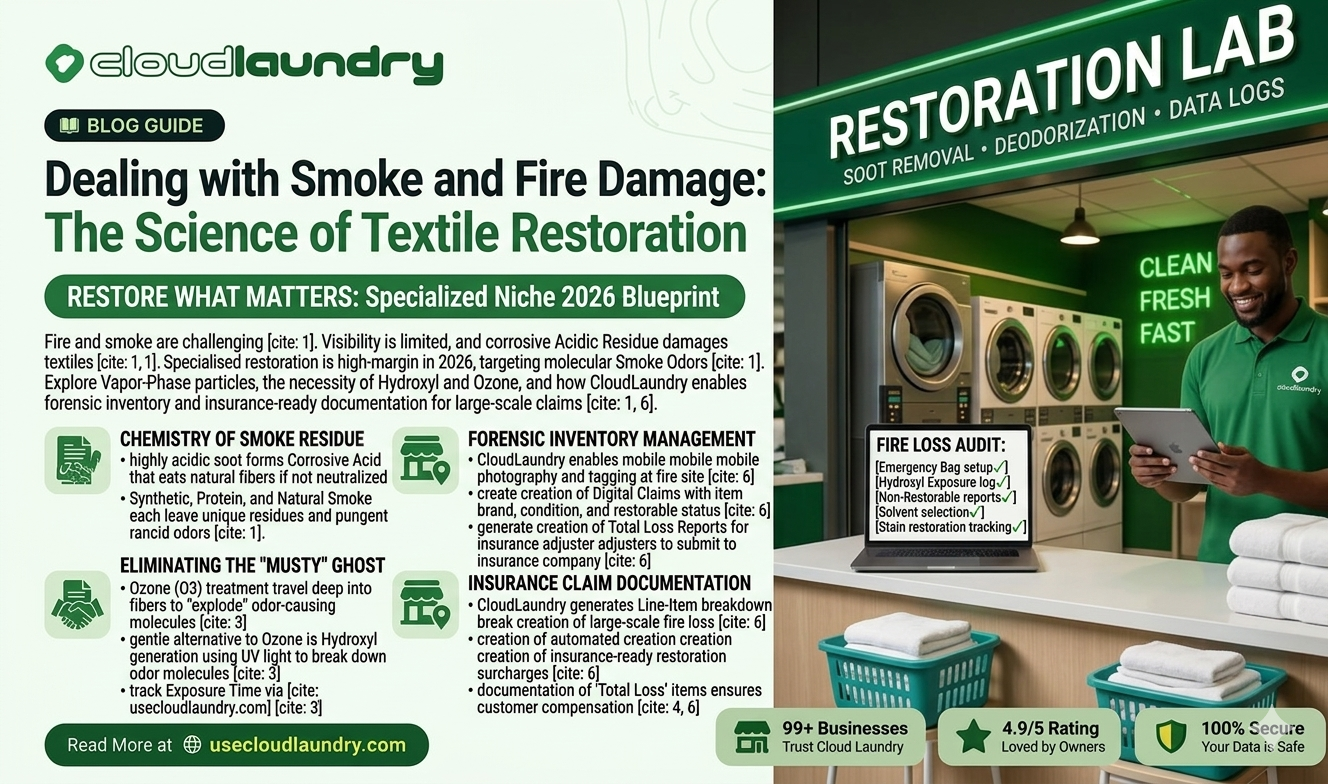
When a fire occurs, the damage to a wardrobe or household textile collection is rarely limited to what the flames touch. The true devastation is carried by the smoke. Smoke is a complex "chemical cocktail" consisting of carbon soot, charred organic matter, and vaporized synthetic chemicals from melted plastics and building materials. These particles are microscopic often less than 0.1 microns in size allowing them to penetrate deep into the "Core" of textile fibers.
In the professional landscape of 2026, professional fire and smoke damage restoration 2026 is no longer a simple cleaning task; it is a decontamination mission. Traditional washing methods often fail because they only address the surface soot while "locking in" the acidic smoke odors. For the modern laundry operator, entering the restoration niche offers a recession-proof revenue stream often funded by insurance companies. However, the complexity of managing thousands of individual items from a single fire loss requires the best tool to manage your laundry business, CloudLaundry, to track every garment from the "Pack-Out" at the fire site to the final "Deodorization" and delivery.
The Chemistry of Smoke Residue
To clean smoke, you must understand what it is made of. Smoke residue is highly acidic. When it meets the moisture in the air or the residual oils in a garment, it forms a "Corrosive Acid" that can eat away at natural fibers like silk and wool if not neutralized within 48 to 72 hours.
The Three Types of Smoke Damage:
- Synthetic Smoke: Caused by burning plastics and electronics. It leaves a "smeared," thick, black residue that is highly localized and extremely difficult to remove without specialized solvents.
- Protein Smoke: Caused by kitchen fires (grease and meat). This residue is virtually invisible but has a pungent, "rancid" odor that permeates everything.
- Natural Smoke: Caused by burning wood or paper. It produces grey/black ash that is easier to vacuum but contains high levels of carbon that can "grey" a fabric permanently if not handled correctly.
The "Dry-First" Protocol: The Mistake of Immediate Washing
The most common mistake in fire restoration is putting a soot-covered garment directly into a washing machine. Water acts as a "carrier," pushing the microscopic soot particles deeper into the fiber weave and creating permanent grey stains.
The Professional Restoration Sequence:
- HEPA Vacuuming: Using high-efficiency particulate air (HEPA) vacuums to "lift" the dry soot off the surface of the fabric before it is ever touched by moisture.
- Chemical Sponging: Using "Dry-Soot Sponges" (made of natural rubber) to "erase" the surface carbon. These sponges work by lifting the soot rather than smearing it.
- Neutralization: Applying a PH-adjusting agent to counteract the acidity of the smoke before the deep-cleaning cycle begins.
Eliminating the "Musty" Ghost: Ozone and Hydroxyls
The most difficult part of restoration is the smell. Smoke odors are trapped in the "pores" of the fiber. In 2026, we use molecular "Air-Scrubbing" technology.
- Ozone (O3) Treatment: Ozone is a powerful oxidant. It travels into the fibers just like smoke did, but instead of leaving a smell, it "explodes" the odor-causing molecules.
- The Risk: Ozone can be aggressive toward rubber and elastic. It must be carefully timed.
- Hydroxyl Generation: Hydroxyls are the "gentle" alternative to Ozone. They occur naturally in the atmosphere and use UV light to break down odor molecules. Unlike Ozone, Hydroxyls are safe for delicate silks and can be used while people (or staff) are in the room. By using usecloudlaundry.com, you can track the "Exposure Time" for every batch, ensuring maximum odor removal without damaging the garment's integrity.
Dealing with "Yellowing" and Thermal Damage
Fires produce intense radiant heat. Even if a garment didn't burn, the heat can "singe" or "toast" the fibers, leading to a permanent yellow or brown cast.
The Heat Threshold: Synthetic fibers like polyester can reach their "Glass Transition" point at relatively low fire-site temperatures. This makes the fiber "tacky," allowing smoke to become "welded" into the plastic structure. If this occurs, the item is generally considered "Non-Restorable." A professional using CloudLaundry will document these "Non-Restorable" items for the insurance adjuster, proving why they cannot be cleaned and ensuring the customer is compensated for the loss.
The Insurance “Pack-Out”: A Logistical Mountain
A single house fire can result in 500 to 2,000 individual textile items (clothes, drapes, bedding, rugs). Managing this inventory while the customer is displaced is a massive undertaking.
The Pack-Out Workflow:
- Categorization: Dividing items into "Salvageable," "Questionable," and "Total Loss."
- Emergency Service: Most fire victims need a "3-Day Emergency Bag" of clothes cleaned immediately so they have something to wear while living in a hotel.
- Long-Term Storage: The rest of the wardrobe must be cleaned and stored until the home is rebuilt.
How CloudLaundry Powers the Restoration Niche
Restoration is a "Data-Heavy" business. You aren't just cleaning for a customer; you are cleaning for an insurance adjuster who requires a "Line-Item" breakdown of every sock, shirt, and curtain. If your documentation is sloppy, you won't get paid.
As the best tool to manage your laundry business, usecloudlaundry.com is the "Restoration Specialist's Database." It is designed to handle the high-volume, high-detail requirements of fire loss:
- Forensic Inventory Tracking: CloudLaundry allows you to use a mobile device to photograph and tag every item at the fire site. This creates a "Digital Claim" that includes the item's brand, condition, and restoration potential.
- Insurance-Compatible Invoicing: The platform can generate invoices that break down the "Restoration Surcharge," the "Ozone Cycle Fee," and the "Long-Term Storage Rate." This makes the insurance adjuster's job easy, which means you get paid faster.
- "Total Loss" Documentation: If an item is too damaged to clean, you can mark it as "Total Loss" in CloudLaundry. The system will generate a "Non-Restorable Report" for the customer to submit to their insurance company.
- Batch Deodorization Logs: You can group items into "Ozone Room Batches." CloudLaundry records the start and end times of the deodorization cycle, providing the "Proof of Process" required for high-value claims. By using CloudLaundry, you transform from a local cleaner into a "Certified Restoration Partner." You provide the level of professional oversight that insurance companies in Nigeria and beyond are now demanding. CloudLaundry ensures that no item is lost in the smoke.
The "Wet Smoke" Challenge
"Wet Smoke" occurs when a fire is smoldering at a low temperature, or when firefighters use water/foam to extinguish the blaze. This creates a thick, sticky, and highly acidic residue.
The Chemical Solution: Wet smoke requires "Emulsification." Professionals use high-alkaline pre-soaks to "liquefy" the tar-like smoke residues so they can be rinsed away. usecloudlaundry.com helps you monitor these specialized chemical costs, ensuring your "Restoration Tier" pricing remains profitable even when using expensive surfactants.
Ultrasonic Cleaning for "Hard-Soft" Items
In 2026, the restoration niche has expanded to include "Soft Content" items like stuffed animals, designer handbags, and shoes.
The Ultrasonic Method: For items that cannot be tumbled, Ultrasonic cleaning uses high-frequency sound waves to create "Cavitation Bubbles" in a cleaning solution. These bubbles "implode" against the surface, pulling soot out of every tiny crevice without mechanical agitation. It is the only way to save a child's favorite toy or a luxury leather boot from fire damage.
Marketing to the "Crisis Network"
You don't market fire restoration to the general public; you market to the "First Responders" of the insurance world.
The B2B Strategy: Build relationships with Insurance Adjusters, Fire Departments, and Property Managers. Use your CloudLaundry portfolio to show them your "Success Rate" and your "Digital Tracking" capabilities. When they see that you use a professional system like usecloudlaundry.com to manage their claims, you become their "Preferred Vendor." In 2026, the laundry that has the best data is the one that gets the contract.
Conclusion: Restoring More Than Just Fabric
Dealing with fire damage is a high-pressure, emotionally charged business. You are meeting customers at one of the worst moments of their lives. When you return their clothes free from soot, smelling fresh, and perfectly pressed you are returning a sense of normalcy and dignity.
Mastering professional fire and smoke damage restoration 2026 is about the intersection of chemistry, logistics, and empathy. By investing in specialized deodorization technology and the best tool to manage your laundry business, usecloudlaundry.com, you can build a highly profitable niche that serves the community in their time of greatest need.
Become the restoration expert your city relies on. Visit CloudLaundry today and see how CloudLaundry can help you manage the most complex claims with total precision. From the ashes, we rebuild.
