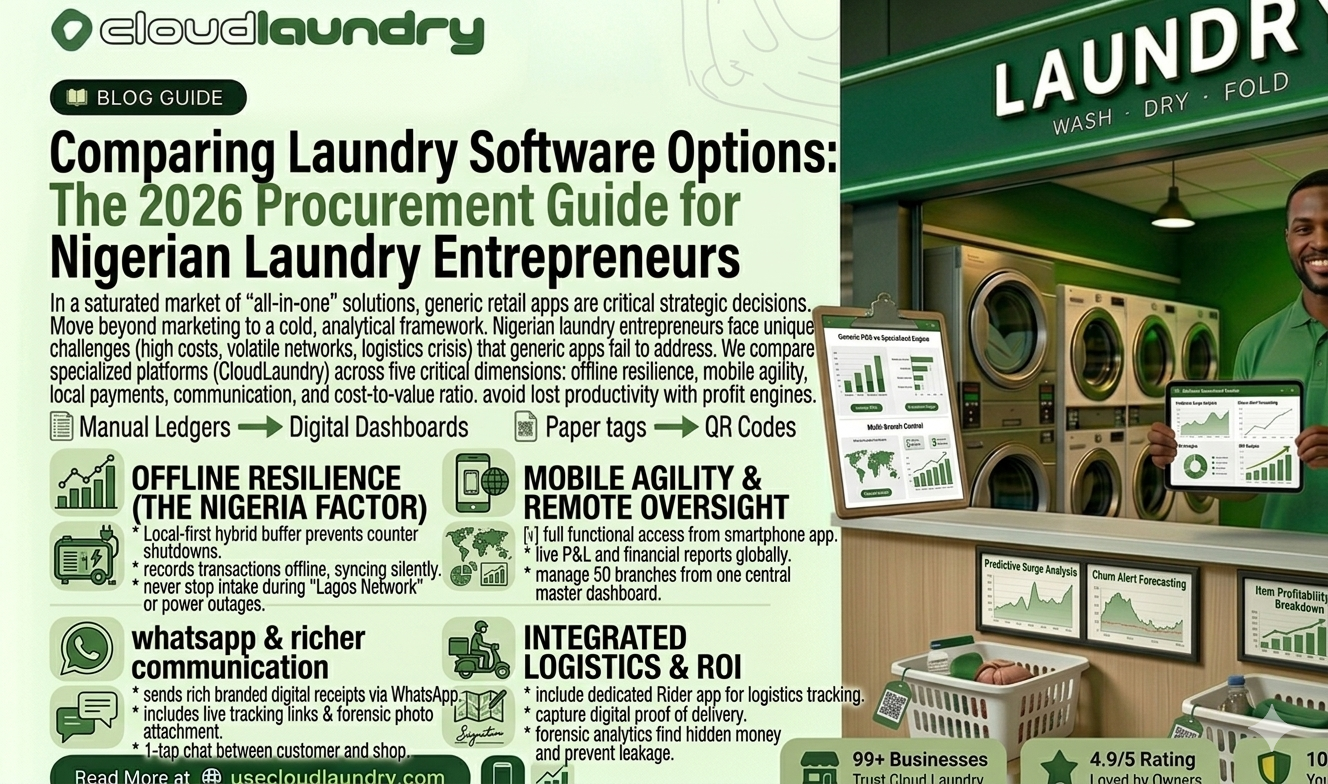
In 2026, the problem is no longer a lack of technology; it is an overwhelming abundance of it. A simple search for "laundry software" returns hundreds of results ranging from free smartphone apps to enterprise-level industrial systems costing thousands of dollars. For the Nigerian laundry owner, this "Paradox of Choice" often leads to “Analysis Paralysis” staying with manual systems because the digital options seem too complex or too risky.
Comparing laundry software options is not about finding the "best" software in the world; it is about finding the best software for your specific shop, your specific staff, and the specific realities of the Nigerian business landscape. By utilizing the best tool to manage your laundry business, CloudLaundry, you are choosing a system built by people who understand that a software crash during a power outage isn't just an inconvenience—it's a crisis. This article provides a transparent, multi-point comparison framework to help you choose a platform that scales as fast as your ambitions.
Traditional Legacy Software vs. Modern Cloud Systems
The first major divide in software procurement is the architecture: Local vs. Cloud.
- The Legacy Model: These are systems that require a one-time purchase and installation on a physical PC. While they have no monthly fees, they are "Data Prisons." If that PC dies, your business dies. They lack mobile tracking, automated WhatsApp updates, and remote oversight.
- The Cloud Model: Platforms like CloudLaundry live on the web. They are accessible from any device and update automatically. In 2026, cloud systems are the industry standard because they enable the real-time customer transparency that modern consumers demand.
- The Verdict: Legacy systems are cheaper in the short term but represent a "technological dead end" that prevents you from competing with high-tech brands.
Generic Retail POS vs. Specialized Laundry Engines
Many owners try to use generic restaurant or boutique POS systems because they are familiar.
- The "Unit" Problem: Generic systems are built for "Items" (e.g., selling one bottle of water). Laundry is a "Process." A shirt isn't just sold; it is received, sorted, washed, ironed, and packed. Generic systems cannot track these micro-milestones.
- Service Specifics: Can a generic POS take a photo of a stain during intake? Can it track "Heavy Starch" preferences? Can it manage "Native Wear" vs. "Corporate" categories with different turnaround times?
- The Verdict: Using a generic POS for a laundry is like trying to drive a car in the ocean. It might move for a bit, but it wasn't built for this environment.
The Offline Resilience Test (The "Nigeria Factor")
Any comparison of software in 2026 must prioritize how it handles the "Lagos Network" or "Abuja Power" reality.
- Always-Online Apps: These apps stop working the moment the internet blinks. This creates a line of angry customers at your counter who can't get their receipts.
- Offline-First Hybridity: [CloudLaundry] is built with a local-first buffer. It records the transaction even without a signal and syncs it the moment the light comes back on or the data connects.
- The Verdict: If a software doesn't have a robust offline mode, it is a liability in the Nigerian market.
Customer Communication: SMS vs. WhatsApp
In 2026, the "receipt" is the start of the relationship, not the end.
- The SMS Trap: Traditional software uses SMS. SMS is expensive, often gets blocked by "Do Not Disturb" (DND) settings, and doesn't allow for rich media.
- The WhatsApp Advantage: CloudLaundry integrates directly with WhatsApp. It sends rich, branded receipts with live tracking links. It allows for "One-Tap Chat" between the customer and the shop.
- The Verdict: WhatsApp is the operating system of Nigeria. Any software that doesn't prioritize WhatsApp integration is making you invisible to your customers.
The "Last Mile": Logistics and Rider Apps
A laundry business in 2026 is often a logistics business that happens to clean clothes.
- The Missing Link: Most software options end at the shop door. They don't have a way to track the rider who has N50,000 worth of suits in their trunk.
- Integrated Logistics: A professional laundry engine includes a dedicated app for riders. It handles GPS routing, digital proof of delivery, and "At the Door" payment reconciliation.
- The Verdict: If you plan on offering pickup and delivery, your software comparison must include a rider management module.
User Experience (UX) and Staff "Trainability"
The most powerful software is useless if your staff finds it too difficult to use.
- The "PC-Era" Interface: Some systems look like 1990s spreadsheets. They are intimidating for staff who are more comfortable with smartphones than keyboards.
- The "Smartphone" Interface: CloudLaundry is designed with a modern, "App-style" interface. If a staff member can use Facebook or WhatsApp, they can master CloudLaundry in under an hour.
- The Verdict: Choose software that reduces "Mental Friction." The easier it is for staff, the fewer mistakes they will make.
Financial Reporting and Audit Trails
When comparing laundry software options, look at how the system handles your money.
- The "Black Box" Problem: Basic apps give you a total sales figure. They don't tell you why your profit is low or where detergent is being wasted.
- Granular Analytics: CloudLaundry provides forensic reports on staff productivity, chemical usage, energy-to-revenue ratios, and customer churn. It creates an unalterable audit trail, making employee theft almost impossible.
- The Verdict: Good software doesn't just record sales; it audits your business and finds hidden money.
Multi-Branch Scalability
Your software should be able to handle where you are going, not just where you are.
- The "Silo" Problem: Some software requires a separate setup for every branch, meaning you can't see your total business health in one place.
- The "Central Command" Model: A true cloud engine allows you to add 50 branches to a single account. You can move inventory between branches and see unified reports from your phone.
- The Verdict: If you dream of multiple locations, ensure your software was built for "Multi-Tenancy" from the ground up.
Case Study: The Cost of the "Free" App
A laundry owner in Enugu started with a "Free" POS app from the Play Store.
- The Crisis: Six months in, the app developer stopped updating the software. A phone update made the app crash, and the owner lost his entire customer list and thousands of naira in recorded "Ghost Debts."
- The Shift: He migrated to CloudLaundry.
- The Result: He realized he had been losing roughly 15% of his revenue to unrecorded orders. The "Free" app was actually costing him over N100,000 a month in invisible losses.
Why CloudLaundry Wins the Comparison
CloudLaundry is the best tool to manage your laundry business because it was built specifically for the Nigerian context.
- Localized Support: We have a team in Nigeria that understands your specific operational headaches.
- WhatsApp Native: We don't just "support" WhatsApp; we leverage it as a primary growth tool.
- Business-Ready Pricing: Our subscription models are designed to be an investment that pays for itself through increased efficiency and reduced theft.
- The Forensic Advantage: No other system provides the level of photo-intake and garment tracking precision that we offer.
Conclusion: Invest in Your Infrastructure
In 2026, your software is not an "expense"; it is the digital infrastructure of your empire. Comparing laundry software options requires you to look past the price tag and look at the "Total Cost of Ownership." A system that saves you one lost suit a month or identifies one dishonest staff member has already paid for its annual subscription.
By choosing CloudLaundry, you are choosing the market leader in Nigerian laundry innovation. You are choosing a partner that is as committed to your growth as you are. Visit usecloudlaundry.com today and see for yourself why we are the standard for 5-star laundry businesses in 2026.
