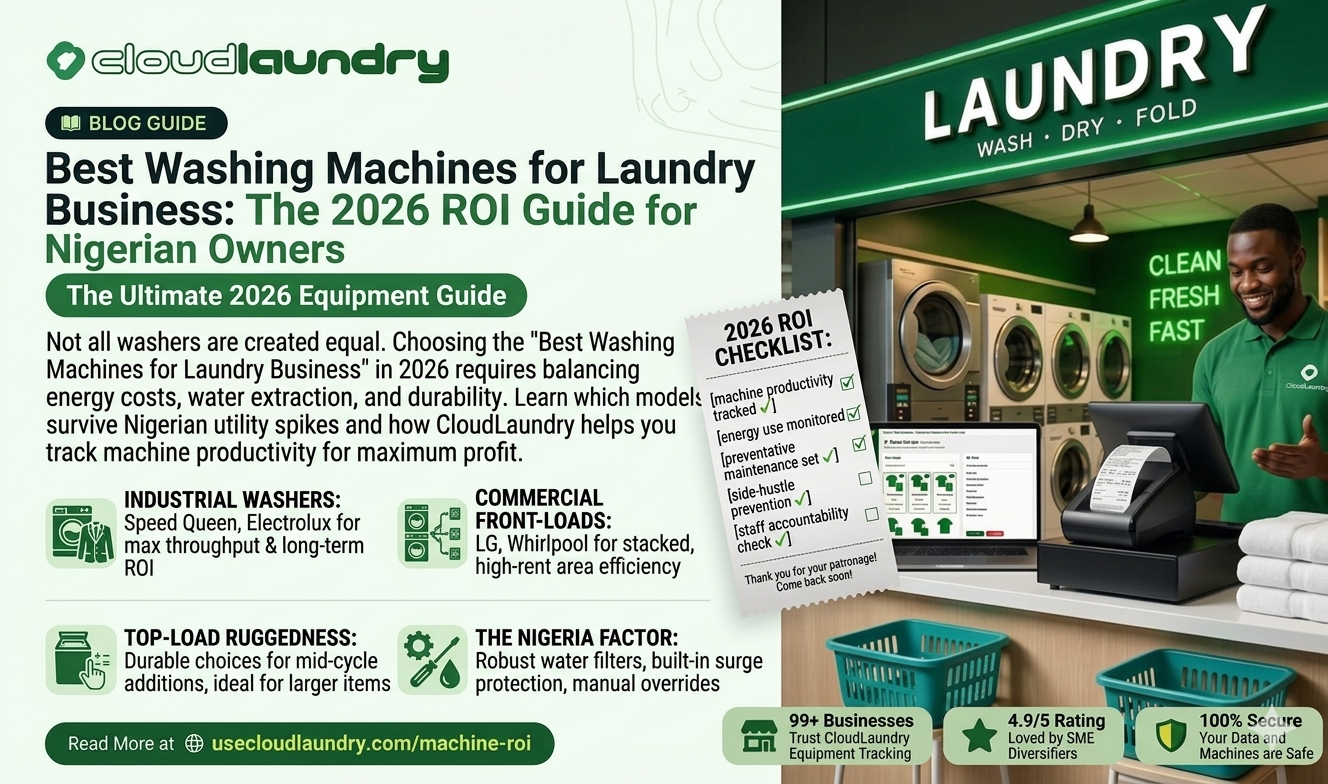
In the heart of any thriving laundry business in Lagos, Abuja, or Port Harcourt, there is a rhythmic humming sound. It is the sound of your washing machines. These machines are not just "appliances"; they are the primary production engines of your enterprise. Every minute a machine is spinning, you are generating revenue. Every minute it sits idle or broken, you are losing money to rent, staff salaries, and customer dissatisfaction.
As we enter 2026, the criteria for the best washing machines for laundry business have shifted. In an era where diesel prices fluctuate and electricity tariffs are rising, "cheap" machines have become the most expensive mistake a Nigerian entrepreneur can make. A machine that costs N500,000 but takes two hours to wash a load and leaves the clothes dripping wet is a "profit killer."
To dominate the market, you need high-performance hardware paired with the best tool to manage your laundry business, CloudLaundry. While your machines handle the physical cleaning, CloudLaundry provides the digital intelligence to track how many cycles each machine runs, preventing staff from running "off-the-book" loads and ensuring you know exactly when it’s time for maintenance. This guide breaks down the top washing machine contenders for 2026, filtered through the lens of the Nigerian operational reality.
The Commercial vs. Domestic Myth
The first hurdle for many new laundry owners is the temptation of the "Home Depot" aisle. You see a "12kg Top Loader" at a retail store for a fraction of the price of a commercial unit. Why not just buy four of those?
- The Durability Gap: Domestic washing machines are engineered for “Average Household Use” roughly 3 to 5 loads per week. In a successful Nigerian laundry shop, a machine will do 5 to 10 loads per day. A domestic machine’s motor, belt, and bearings are not designed for this heat and friction. Within six months, the drum will likely begin to sag, or the motherboard will fry.
- The "Fast" Factor: The best washing machines for laundry business are built for speed. A domestic front-loader often has a "Cotton Eco" cycle that lasts 2.5 hours. A commercial-grade machine, designed to be hooked up to a hot water source, can finish a superior wash in 30 to 45 minutes. Speed equals turnover. If you can do three loads in the time your competitor does one, you have tripled your revenue potential without increasing your floor space.
Top Load vs. Front Load: The 2026 Performance Debate
In the Nigerian market, the choice between top loaders and front loaders is often dictated by water habits and fabric types.
- Top Loaders (The "Rugged" Choice): Many Nigerian shops prefer top loaders because they are perceived as more "rugged" and easier to repair. They allow for "mid-cycle additions" (when a staff member finds a forgotten sock) and generally handle the heavy weight of wet towels or bedsheets well. However, they use significantly more water and detergent, and their "agitator" systems can be harsh on delicate lace and high-end silk.
- Front Loaders (The "Efficiency" King): Front loaders are the gold standard for the best washing machines for laundry business in 2026.
- Mechanical Action: They use a tumbling action that is gentler on expensive Agbadas and suits.
- High Extraction: Front loaders spin at much higher G-forces (often 1000+ RPM). This "extracts" more water, meaning the clothes come out only slightly damp. This reduces your drying time and your gas/electricity bill by 50%.
- Stackability: In high-rent areas like Victoria Island, front loaders allow you to stack a dryer on top, doubling your production capacity in the same square footage.
The Heavyweight Champion: Speed Queen (Alliance Laundry Systems)
If you ask any veteran laundry owner in Nigeria what the "best" machine is, the answer is almost always Speed Queen.
- Why it Wins: Speed Queen machines are built with "Metal where it Matters." While other brands have moved to plastic tubs and electronic touchscreens, Speed Queen’s commercial line still uses stainless steel tubs and heavy-duty components that are rated for 10,400 cycles (roughly 25 years of home use, or 5-8 years of intense commercial use).
- The 2026 Edge: Their mechanical-dial models are particularly famous in Nigeria because they are "dumb" in the best way possible. They don't have sensitive computer chips that fry during a power surge. They are workhorses that just keep spinning. For an owner using usecloudlaundry.com to track orders, having a machine that never goes down ensures the digital workflow is never interrupted.
The Tech-Forward Challenger: LG Commercial
While Speed Queen wins on brute force, LG has taken over the "Smart Laundry" sector in Nigeria. The LG Giant-C and Titan-C commercial series are specifically designed for small-to-medium laundromats.
Key Features:
- Inverter Direct Drive: Unlike traditional machines with belts and pulleys, LG motors are attached directly to the drum. This means fewer moving parts to break and much quieter operation ideal if your shop is located in a residential apartment block.
- Atomizing System: LG uses a high-pressure nozzle to spray water directly onto the clothes, which helps detergent penetrate faster and reduces water consumption.
- Small Footprint: These machines provide commercial power in a size that fits through a standard Nigerian doorway, avoiding the need to break walls for installation.
The "Industrial" Tier: Electrolux and Girbau
If your 2026 strategy involves a high-volume factory model (processing for hotels, hospitals, or multiple collection centers), you need to step into the Industrial tier.
- Electrolux Professional: These machines are the "MacBooks" of the laundry world. They feature highly advanced "Compass Pro" microprocessors. When integrated with a management system like CloudLaundry, they provide data on exactly how much water and energy was used per load, allowing you to calculate your exact profit per shirt.
- Girbau: Based in Spain but with strong distribution in Nigeria, Girbau machines are famous for their "Soft-Mount" technology. These machines have high-performance shock absorbers, meaning they don't need to be bolted into a massive concrete foundation. This makes them the best washing machines for laundry business owners who are renting their space and want the flexibility to move locations in the future.
ROI Case Study: The "Owerri Efficiency" Transformation
"Obinna" opened a laundry in Owerri with six domestic top-loading machines. He was happy with the low startup cost. However, a year later, his business was struggling. His electricity bill was N200,000 a month, and he was constantly paying a technician to fix broken belts. Customers complained that their clothes were still "damp" and smelled musty because his domestic dryers couldn't keep up with the wet clothes coming out of the top loaders.
The Pivot: Obinna sold his domestic fleet and invested in three LG Commercial Front Loaders and two matching dryers.
The Result: Even though he had fewer machines, his "Turnaround Time" improved. The high-spin extraction of the LGs meant drying took 30 minutes instead of 90.
The Data: By using usecloudlaundry.com, Obinna tracked his "Utility-to-Revenue" ratio. He found that his electricity bill dropped by 35% while his capacity to handle orders increased by 40%. The "expensive" machines paid for themselves in exactly 11 months.
The "Nigeria Factor": What to Look for Before You Buy
When shopping for the best washing machines for laundry business in 2026, you must look past the brochure and consider the "Naija Reality."
- Voltage Fluctuations: Does the machine have a built-in surge protector, or will you need to invest in a massive industrial stabilizer?
- Water Quality: Nigerian groundwater (borehole water) is often "hard" or contains iron. This can clog sensitive solenoids in high-tech European machines. Look for machines with robust, cleanable water filters.
- Spare Parts Availability: Never buy a "rare" brand. If a N5,000 pump breaks and you have to wait three weeks for it to arrive from Turkey, your business is paralyzed. Stick to brands with established technicians in Lagos or Abuja.
- Manual Overrides: In case of a total system glitch, can the machine be drained manually? This prevents clothes from being "trapped" inside during a power failure.
Management & Accountability: Linking Hardware to Software
Even the best machine can be a tool for theft if it isn't managed. One of the biggest "leaks" in Nigerian laundry is “Side Hustling” staff members using your machines to wash clothes for their friends without logging the order.
This is why CloudLaundry is the best tool to manage your laundry business. By matching the number of orders in your CloudLaundry dashboard with the "Cycle Count" on your professional machines (most commercial LGs and Speed Queens have a non-resettable cycle counter), you can spot discrepancies instantly. If CloudLaundry says you processed 20 orders, but your machines ran 35 cycles, you know exactly what is happening in your shop when you aren't there.
Maintenance: Protecting Your N20M Investment
The "Best" machine will become the "Worst" machine if it isn't maintained. In 2026, a proactive maintenance schedule is non-negotiable.
- Daily: Clean the door gaskets and leave the doors open to prevent mold.
- Weekly: Clean the lint filters and detergent drawers.
- Monthly: Perform a "Drum Clean" cycle with descaling chemicals to remove calcium buildup from borehole water.
- Quarterly: Have a technician check the heating elements and motor brushes.
Using the "Task Management" feature in usecloudlaundry.com, you can set automated reminders for your staff to perform these checks, ensuring your machines reach their 10-year lifespan.
Summary of Recommended Models for 2026
The "Built-to-Last" Pick: Speed Queen Quantum Gold (Front Load).
The "Value for Money" Pick: LG Giant-C Commercial.
The "Space Saver" Pick: Whirlpool Commercial Stacked Washer/Dryer.
The "High-Volume Factory" Pick: Electrolux Line 6000.
Conclusion: Choose for the Future, Not Just Today
Procuring the best washing machines for laundry business is the most significant capital expenditure you will make. It is tempting to save N2M today by buying lower-grade equipment, but in the fast-paced 2026 Nigerian market, that "saving" will be eaten by repairs, high utility bills, and lost customers within a year.
Invest in machines that offer high-speed extraction, low water consumption, and proven durability in the Nigerian climate. When you pair this high-quality hardware with the specialized management capabilities of CloudLaundry, you create a business that is efficient, transparent, and ready to scale.
Your machines provide the "Clean," but CloudLaundry provides the "Control." Together, they are the foundation of a 2026 laundry empire. Visit usecloudlaundry.com today to see how we can help you manage your equipment, your team, and your growth.